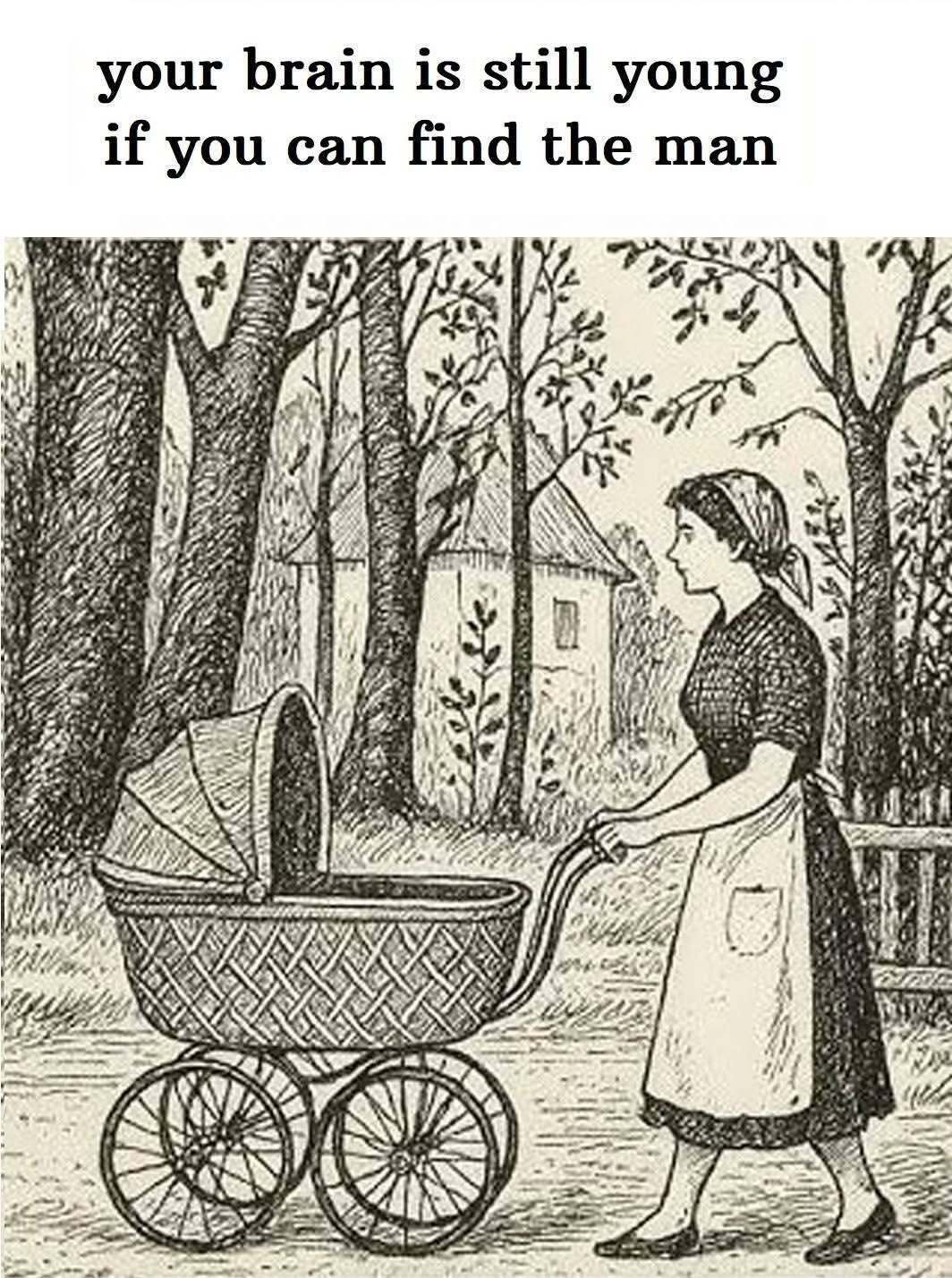
A classic optical illusion is challenging viewers of every age today.


A Puzzle That Refuses to Fade Away
Every few years, a classic optical illusion makes its way back across social media, attracting a new generation of curious viewers. One of the most intriguing examples is a black-and-white drawing featuring a woman pushing a baby carriage through a wooded path. The challenge seems straightforward: find the hidden man concealed within the image.
At first glance, many people see only what appears to be an ordinary countryside scene. A woman walks beside a stroller while trees stand quietly in the background. Yet those who spend a little more time examining the illustration soon discover that the picture contains something entirely unexpected.
The puzzle has been shared countless times with captions claiming that only people with “young eyes” can spot the hidden figure. While that statement is more playful than scientific, it certainly adds to the mystery and encourages viewers to test themselves.
What makes this illusion so fascinating is that the hidden image is not immediately obvious. Instead, the artist cleverly blends facial features into the surrounding scenery, forcing the brain to shift perspectives before the concealed figure becomes visible.
Why Our Brains Love Optical Illusions
Continued on next page:
Optical illusions have fascinated people for centuries because they reveal how the human brain processes information. Rather than seeing every detail individually, our minds constantly look for patterns and familiar shapes.
When we examine an image, the brain quickly creates an interpretation based on past experiences. This helps us understand our environment efficiently, but it can also cause us to overlook hidden elements.
In puzzles like this one, the artist takes advantage of that tendency. By disguising a face within trees, shadows, and other objects, the illustration tricks viewers into focusing on the obvious scene while ignoring the secondary image hidden in plain sight.
Researchers often use visual illusions to study perception, attention, and cognitive processing. These puzzles demonstrate that seeing is not always as simple as opening our eyes. Sometimes, the brain itself determines what we notice—and what we miss.


The Secret Behind the Hidden Man
For those struggling to find the answer, the key is to stop focusing on the woman and the stroller. Instead, look at the arrangement of the trees and surrounding shapes.
The hidden man’s face emerges when the viewer interprets parts of the landscape as facial features. What initially appear to be tree trunks and shadows suddenly transform into a forehead, eyes, nose, and mouth.
This moment of realization is what makes the illusion so satisfying. Once the hidden figure becomes visible, many people wonder how they missed it in the first place.
Interestingly, different viewers notice different details first. Some immediately spot the hidden face, while others may search for several minutes before recognizing it. This variation highlights how differently individual brains process visual information.