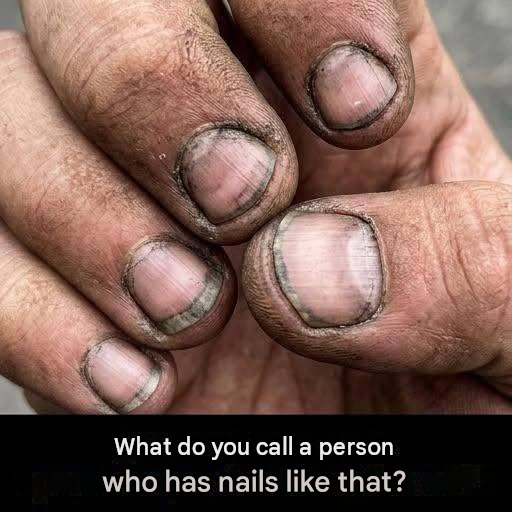
Dirty fingernails often trigger snap judgments, ranging from perceived negligence to poor hygiene. However, this detail sometimes masks a very different reality and, above all, reveals a great deal about how we perceive others. A hand with dirty nails, blackened by grime, and judgment arises almost instantly. Negligence? Poor hygiene? Or simply the result of a long workday? This seemingly innocuous question often reveals much more about how we perceive others than about the person themselves. What if this detail, which we so readily associate with a negative image, actually tells a completely different story?
Biology
Why do dirty fingernails trigger immediate judgment?
In our daily lives, hygiene is fundamental. Clean hands and well-groomed nails are associated with health, self-esteem, and respect for others. From childhood, we are taught to wash our hands regularly, trim our nails, and avoid the accumulation of dirt.
Thus, when we see blackened or stained nails, our reaction is usually immediate: we spontaneously think of a lack of care. In certain contexts, this may be true, especially when conditions facilitate washing and personal hygiene. However, reducing this observation to a single explanation would be overly simplistic.
When fingernails tell the story of a workday. Because there’s another, often forgotten, reality. Dirty fingernails can also be a sign of intense manual labor. Mechanic, gardener, craftsperson, construction worker, farmer… many professions involve direct contact with soil, materials, oils, or dust.
In these situations, dirt is neither a choice nor a sign of neglect, but simply the visible trace of physical exertion. Even after thorough washing, some substances sometimes remain embedded. The hands then become a reflection of a day spent building, repairing, or producing.
Anatomy
This perspective completely changes the initial perception: what might have seemed neglected actually becomes an indicator of activity and work.
The importance of context before judging. The key lies here: without context, it is impossible to reach a correct conclusion. The same detail can have completely opposite meanings depending on the situation.
Dirty fingernails during a job interview or a formal event might raise eyebrows. However, after a day on a construction site or in a garden, they tell a very different story. In one case, they might suggest carelessness; in the other, dedication and hard work.
Biology
This simple example reminds us how deceptive our hasty judgments can be. What we see is only a part of reality, rarely the whole story .
What our perceptions say about us
Beyond hygiene or work, this issue highlights a broader phenomenon: our tendency to interpret appearances. We often associate cleanliness with success and disorder with a lack of discipline.
However, this interpretation is far from always accurate. Many people who work hard every day show visible signs of their activity, while others, less physically exposed, may appear flawless without necessarily having “produced” in the concrete sense of the term.
Searching for people
This invites deeper reflection on how we evaluate others, sometimes too quickly, based solely on visual criteria.
So, what do you call a person with nails like that?
There’s no single answer. It could be a worker after a long day, a parent doing DIY projects, an amateur gardener, or simply someone who hasn’t washed their hands yet. In other cases, it could reflect a lack of hygiene.