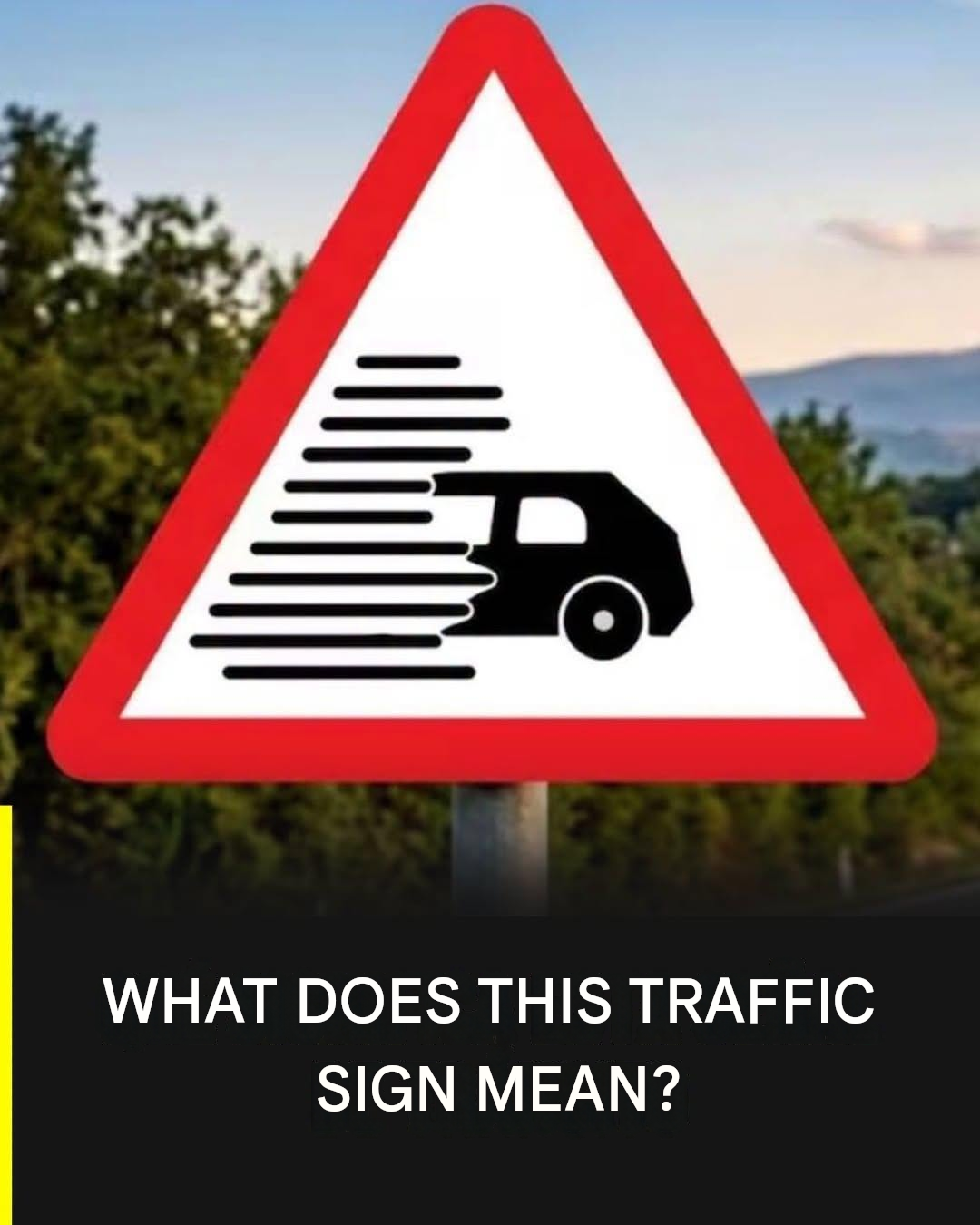
case, the lines that partially cross the vehicle obstruct the driver’s view of the road and surroundings.
One of the most common situations associated with this sign is the presence of fog. When a fog bank covers a road, the distance at which other vehicles, signs, curves, or road features can be distinguished can decrease considerably. The difficulty may appear gradually or occur suddenly upon entering an affected area.
But fog isn’t the only circumstance that can trigger this warning. Reduced visibility can also be caused by smoke, dust, heavy rain, or certain environmental conditions. In some places, even particulate matter after a fire or waterspouts generated during a storm can impair a driver’s vision.
The importance of this type of sign lies precisely in its ability to anticipate the problem. The goal is not to indicate that the danger is already present at the exact location of the sign, but rather to warn that conditions may change a few meters ahead.
For this reason, when a driver encounters this warning sign, they should interpret it as an invitation to modify their driving. The first step is to gradually reduce speed and adapt their driving to the actual road conditions.
There is no single speed limit that can be applied to all situations of reduced visibility. A safe speed depends on factors such as fog intensity, road conditions, traffic, lighting, and the distance the driver can see. Therefore, numerical references associated with certain national codes or recommendations should not be interpreted as a single international rule.
It’s also important to increase the following distance from the vehicle in front. When visibility decreases, the time available to react to sudden braking or an unexpected change in traffic can also be reduced. Maintaining a greater distance allows for more time to react.
Another key aspect is using the vehicle’s lights correctly. In fog, heavy rain, or smoke, low beams are usually more appropriate than high beams, as the latter can create glare that further impairs visibility. Furthermore, drivers must obey local regulations regarding the use of fog lights when their vehicle is equipped with them.
Overtaking should also be avoided when visibility is limited. A maneuver that can normally be performed safely can become much riskier when there is insufficient visibility of oncoming vehicles or obstacles that may appear on the road.
The sign is also important for those traveling on international routes. The existence of harmonized pictograms allows a person to understand certain warnings even when driving in a country whose language they don’t know. In this sense, the standardization of signs is an important tool for road safety.
The Vienna Convention established criteria designed to facilitate this international understanding. Among the models considered are various warning signs related to traffic conditions and the risks that may be encountered on certain sections of road.
Visual variations can be found in different national signage systems. Some may more directly represent the phenomenon being warned about, while others use similar symbols to communicate limited visibility. Therefore, it is always advisable to consult the traffic regulations for the country where you are driving.
If visibility becomes extremely reduced, continuing to drive may no longer be a safe option. In these circumstances, it is advisable to find a safe place off the road to stop, provided it is possible and permitted. The priority should be to avoid being stopped in an area where other vehicles may not see the car.
It is also important to remember that stopping on a road requires taking safety precautions. The vehicle must be positioned so as not to obstruct traffic, and the appropriate signals must be used according to current regulations.
Beyond the exact meaning of the pictogram, the central idea of this triangular sign is simple: visibility conditions can change and the driver must be prepared to adapt their behavior.
Recognizing these conditions allows you to anticipate situations that may arise due to fog, smoke, heavy rain, or other phenomena. Reducing speed, maintaining a safe following distance, using lights correctly, and avoiding unnecessary maneuvers are some of the measures that can contribute to safer driving.
In short, the sign showing a car partially covered by horizontal lines should not be interpreted as a mere decorative warning. It is a call to pay special attention to the road and the conditions that may lie ahead.
Knowing the meaning of traffic signs is a fundamental part of responsible driving. Understanding these symbols allows you to react more quickly, anticipate potential difficulties, and make more prudent decisions when road conditions change.